Classics
AI talks and interviews worth rewatching: Karpathy, Sam Altman, Ilya, Andrew Ng, Jensen Huang… each with Laojin's summary and key takeaways.
 29:49
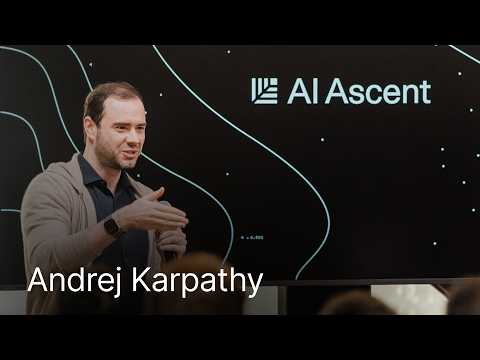
29:49Karpathy: from vibe coding to agentic engineering
Karpathy coined the term 'vibe coding'. In this 2026 Sequoia conversation he pushes the idea one step further: from casually letting AI write code to disciplined 'agentic engineering' — how to bound an agent's scope, how to split work between human and machine, and when to trust versus when to keep a human hand on the brake. Half an hour that captures the real dividing line as AI coding moves from toy to production.
Watch 39:31
39:31Karpathy: Software Is Changing, Again (Software 3.0)
Andrej Karpathy — OpenAI founding member and former Tesla AI director — is the clearest explainer of large models working today. In this June 2025 talk at YC's AI Startup School he frames 'Software 3.0': Software 1.0 is code, 2.0 is neural-net weights, and 3.0 is programming LLMs in natural language. With metaphors like 'LLMs are the new operating system' and 'partial-autonomy products', he lays out how software should be designed in the AI era. If you build AI products, these 40 minutes are the best-spent 40 minutes right now.
Watch 3:31:23
Deep Dive into LLMs like ChatGPT
The 2025 'full edition': over three and a half hours Karpathy walks the entire pipeline behind products like ChatGPT — data, tokenization, pretraining, post-training, inference, tool use, hallucinations and mitigations. A full level deeper than the 2023 one-hour talk, now covering reasoning ('thinking') models and RL post-training. Block out an afternoon; afterwards there's no generation gap between you and your engineers.
Watch 1:03:03
Jensen Huang's vision for the future, with Cleo Abram
Jensen Huang, NVIDIA's founder, is the biggest shovel-seller of the AI compute era. Cleo Abram's rare interview gets him to lay out the full logic of 'accelerated computing': why Moore's law yields to parallel computing, why data centers are now 'AI factories', and why robotics and physical AI are the next curve. Grand narrative, concrete examples — one hour to grasp the technical conviction behind a trillion-dollar company and why the compute business is the foundation of every AI business.
Watch 26:52
26:52Andrew Ng on the rise of AI agents and agentic reasoning
Andrew Ng — Coursera founder, former chief scientist at Baidu and Google Brain — is AI adoption's most patient evangelist. This Snowflake BUILD 2024 keynote is the canonical version of his 'agentic workflows' thesis: stop debating the definition of an agent and design workflows by degree of autonomy; the four design patterns — reflection, tool use, planning and multi-agent collaboration — often lift performance more than a bigger model would. In 27 minutes he shows why enterprises should start with agentic processes, not model parameters.
Watch 5:15:00
Dario Amodei on Claude, AGI and the future of AI & humanity
A five-hour deep conversation with Anthropic CEO Dario Amodei (first half), plus segments with alignment researcher Amanda Askell and interpretability pioneer Chris Olah. Dario is the most systematic exponent of the scaling path: why models will keep improving, why safety is an engineering discipline rather than a slogan, and the 'compressed 21st century' vision from Machines of Loving Grace. The clearest account of how Anthropic's methodology genuinely differs from OpenAI's.
Watch 1:55:10
Sam Altman on GPT-5, Sora and the board saga
OpenAI CEO Sam Altman's first long conversation after the 'coup' that briefly removed him: inside the seven-day board saga, his disagreements with Ilya and Elon, the direction of GPT-5, why Sora matters, and how he thinks about AGI and power. The timing makes it special — the world had just seen OpenAI at its most fragile, and Altman's answers are unusually concrete. The most first-hand episode for understanding what the industry's defining company is thinking.
Watch 59:48
59:48Intro to Large Language Models — the one-hour talk
Karpathy's first public lecture after leaving Tesla: in one hour he covers what LLMs are, how they're trained, and where they're heading. No math required, yet he explains 'the model as a lossy compression of the internet', how next-token prediction grows intelligence, what RLHF does, and why tool use is the direction. Tens of millions of views and the source text for countless explainers — hand this to any non-technical colleague.
Watch 57:21
57:21Ilya Sutskever: An Observation on Generalization
Ilya Sutskever — OpenAI co-founder and former chief scientist, one of deep learning's founders — rarely speaks in public. This 2023 Simons Institute talk at Berkeley distills his thinking: why next-token prediction suffices to learn the deep structure of the world, why unsupervised learning works, and his famous 'feel the AGI'. One of the sources of the endlessly quoted 'compression is intelligence' idea. One hour to understand the theoretical root of the LLM faith.
Watch 1:56:20
Let's build GPT from scratch, in code
The classic hands-on Transformer tutorial: Karpathy opens an empty file and, in under two hours, builds a working nano-GPT from character-level tokenization up. Self-attention, multi-head attention, residual connections and LayerNorm all become runnable PyTorch. Even without coding, watching it once demystifies what 'attention' actually computes — the single most effective video for de-magicking LLMs.
Watch